FINANCING AS LOW AS 0% APR ON APPROVED CREDIT. FIND OUT MORE




Chemical Free Hot Tubbing
Chemical Free Hot Tubs; is it possible?
This is a very popular subject and a question many customers ask us all the time. The answer is NO because in addition to keeping your tub sanitary you need to keep the water balanced (adjusted for alkalinity, pH and water hardness). The later involves adding products which adjust the water chemistry to bring it in line with ideal "pH Neutral" levels. Having neutral water to begin with is very important as it affects how the water reacts with the heater elements, your skin, and how effective the sanitizers will be. Without neutral water, problems will quickly arise. Balancing chemicals such as pH up, pH down, Alkalinity rise, calcium increase, are seldom discussed as chemicals. However, these by definition are certainly chemicals, and as such make it impossible to say that NO chemicals can be used.
When most people ask about "chemical free systems", they are usually referring to traditional sanitization chemicals such as Bromine and Chlorine. "Can I use a wooden hot tub without any harsh sanitizing chemicals such as chlorine and bromine?" As suggested, for the sake of this article we will consider "chemicals" to be considered the Halogens family in the form of Bromine or Chlorine. So, the question should be reframed to, "are there effective skin and health friendly alternatives to using chlorine or bromine in keeping a hot tub sanitized?"
It seems very logical that customers seeking a natural hot tub soak provided by a wooden hot tub, would also want that experience to be free of these chemicals. The problem with any type of hot tub, wooden or plastic, is that the high temperature conditions, ratio of persons per unit volume of water, and frequent use, are a perfect mix for breeding bacteria and algae. 3 persons in a small hot tub is equivalent to 300 people in a backyard pool.
To answer the question of safe alternatives, we 1st must understand what function chlorine and bromine have in a pool or hot tub. Once we clearly understand their functions we can then address substitute products.
The USA's EPA certifies Chlorine and Bromine as two safe chemicals for water control in pools and spas. Specifically, they certify their ability to safely sanitize and oxidize a pool or spa. When used properly these chemicals are considered safe, otherwise they would not have EPA and other countries equivalent approval. Until recent times, these chemicals have long been considered the main pool and spa sanitizers.
The debate on which chemical to use (bromine or chlorine) is ongoing, however on a wooden hot tub the choice is one sided. Bromine is the sanitizer of choice simply because Chlorine under specific circumstances can break down the wood fiber causing irreversible damage to the tub. Besides this important fact, Bromine is considered to have fewer odors and is more stable than chlorine at high temperatures (chlorine "gases off" after 98 degrees).
Now to discuss alternatives, we need to clearly understand the two processes that bromine (chlorine) provides in a hot tub or spa. These are to sanitize and to oxidize, as this is ultimately the functions we require when looking for alternatives.
What is a sanitizer?
A restricted definition for a "sanitizer", as used in the pool and spa industry, is any product that destroys live bacteria and viruses, present in the water or on wetted surfaces. Chlorine and Bromine's are EPA approved sanitizers in that sense. Under the right concentration and provided the pH is in the 6.8-7.5 range, which is comfortable for our skin, both will kill any bacteria that impose a health risk. They are members of the Halogen family and when combined with water form a sanitizing chemical HOCl (hypochlorous acid) or HOBr (hypobromous acid) which when in contact with bacteria and viruses will destroy them (depending on the contact time and concentration of the chemical). Bromine and Chlorine when dissolved in water further also produce oxidizer radicals, which will be discussed later. We will limit our choice to bromine as chlorine can attack the wood and break down the fibers. It should be obvious however, that bacteria and virus killing properties are not unique to only chlorine and bromine. The question will be whether the alternatives can get the job done effectively or entirely on their own.
What is an Oxidizer?
While oxidizer and oxidation suggest having to do with a chemical reaction involving oxygen, in chemistry oxidation is defined in terms of a reaction where the substance (being oxidized) gives up electrons to the element or compound that take away the electrons (the oxidizer). Of course, in doing so the original property of the substance being oxidized is destroyed. Common oxidizers (elements or compounds that easily attract electrons, include the halogens (chlorine, bromine, etc.), oxygen, ozone, potassium monopersulfate (MPS), to name some. In the hot tub situation, the important thing to note is that organic compounds, including oils, lotions, as well as living microbes, contain hydrogen and carbon and thus can be susceptible to being destroyed by the right oxidizer. A strong oxidizer (in the pool and spa industry is often referred to a shock) can meet both definitions of being an oxidizer and a sanitizer.
When bromine gas is dissolved in water it forms the sanitizer HOBr and the oxidizer OBr- (hypobromite ion). At the normal target pH levels of 6.8 -7.5, a very high percentage of the bromine is converted to HOBr and thus it is effective in its sanitizing role, but the OBr- ions have a relatively low concentration and therefore bromine is not so effective in its oxidizer role. Thus, in a bromine system we recommend using an additional oxidizer (MPS or Ozone) to aid in oxidizing contaminants such as oils, lotions dead skin as well as destroy bacteria quickly.
What has all this got to do with alternatives to chlorine and bromine? We need to understand how these products work to lay a framework for understanding the alternatives.
What is Ozone?
It is a powerful oxidizer that breaks down the organic contaminants but also oxidizes and therefore destroys most bacteria. Therefore, it can be considered in a dual role, an oxidizer and a sanitizer. Unfortunately, there are a few bacteria that ozone does not treat effectively and for this reason the EPA requires that some chlorine or bromine still be used with ozonators. Fortunately, these bacteria are easily destroyed by smaller concentrations of chlorine or bromine and it doesn't take a high dosage to do so. This allows one to reduce the levels of Bromine/Chlorine normally used by up to 50%.
Ozone is produced by either passing an electricity discharge through air or shining UV light through air. With either method a certain percentage of the stable form of oxygen, O2, that encounters the electric discharge or UV light is transformed, to the less stable O3 molecule (ozone). The ozone, however, is looking to rob electrons so it can get back to a more stable form. That is what makes it an excellent oxidizer. The ozone enriched air is injected into the hot tub water where it can then oxidize bacteria and contaminants. Ozonators for consumer hot tubs come mostly of the uV type. Corona discharge ozonators produce considerably more ozone but are intolerant to high humidity and to keep them working and not have them fail prematurely the air needs to be dried. To do this all properly, results in complete corona discharge ozonators being quite expensive, relative to UV systems.
Does ozone have drawbacks? Ozone dissipates very quickly and there is no such thing as an ozone reserve, thus if no ozone is being injected, such as if the filtration cycle is off, there is no oxidation or sanitation going on. For the consumer there is also no practical measurement for ozone. And as mentioned ozone does not destroy all bacteria and some use of bromine and of a non-chlorine shock still needs to be used.
What are Mineral Ionization Systems?
This is another alternative way of killing microbes. These are commonly known as mineral ionization systems, since often the metals come in mineral forms. The metals used for this purpose are normally copper and silver. When ionized by water these minerals form positively charged ions that are released into the water and float around within the water. Bacteria ingest these ions and are either killed by them or are sensitized or made much more susceptible to other mechanisms then destroying them. These ionization systems will control bacteria, and algae, but because they do not oxidize, a hot tub still requires an oxidizer such as chlorine or bromine (or alternative such as ozone or MPS) to be added to treat the other contaminates. Northern Lights Cedar Tubs uses the inline "Spa Frog" silver mineral cartridges, because they work well with bromine. Products like Nature II or ApaRx are formulated for use with chlorine only, which we want to avoid with wooden hot tubs. The Spa Frog silver ionization products conveniently fits inside the filter dispenser hidden form bathers and provides a slow release of ions. Typically, the dispenser will last to 4 month. This makes them very convenient.
What are Natural Enzyme Products?
One item often overlooked, although is included in every Northern Lights Cedar Tub "Starter Chemical Kit", is our natural enzyme-based clarifier product. This is an excellent supplement to any hot tub. This is a natural 'food grade' enzyme (safe to digest) that eats away body oils and skin debris that attach to the spa surface giving it the "ring around the tub" expression. It also helps keep your filter clogging therefore making it last longer and work better. These oils can be a breeding ground for bacteria so by removing them you reduce the bacteria's food source. It also eliminates foul odors that can build up. Of course whatever the enzymes can dispose of, the oxidation products don't have to deal with, making them more effective.
MPS - none chlorine shock
MPS (Monopersulfate) is a product originally developed by DuPont® under the trade name Oxy-Out. This is a highly effective oxidizing agent. When used in full strength it is often referred to as non-chlorine and bromine "Shock", because of its effectiveness to destroy and remove contaminants and bacteria. Similar to ozone MPS can act as both a sanitizer and an oxidizer. When used on a regular moderate basis, MPS will provide strong residual oxidizing protection to the hot tub. In our chemical line we include a product called Energize which is a pH stabilized form of MPS that can be used regularly to aid in the oxidation process in a hot tub. When excessive hot tub use results in excessive contamination, MPS products can be added in a larger quantity to quickly shock and destroy the contaminants, restoring clarity.
Summary
In summary, if you are using a wooden hot tub you must ensure the products you use don't attack wood. This eliminates use of chlorine products. According to EPA guidelines, you must still use some amounts of halogen sanitizer (Bromine). The amount required will be based on the amount of alternative sanitizers you use. As you add alternative sanitizers, you can begin to reduce the amount of halogen sanitizers. For example, using an ozonator with a mineral cartridge can reduce the required bromine by up to 80 %. Using Natural Enzymes as well as MPS oxidizer can further reduce the requirement for Bromine.
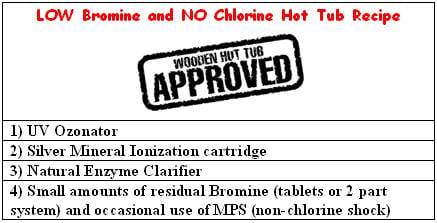
So. for those who are disposed against bromine or chlorine, there are workable alternatives. The above-mentioned alternatives are the ones we have found effective in conjunction with a wooden hot tub. We will not sell products that can lead to early wood deterioration, which means we avoid selling certain products and caution customer to check with us before using any off-the-shelf chemicals. Most Pool and Spa sales people know very little about wooden hot tubs! Even if you own another brand of wooden hot tub, or own a plastic spa, you can still use the same chemical alternatives that we use. These are available at Cedar Tubs Direct https://www.cedartubsdirect.com/ . This store contains all the products we recommend. You can also sign up to receive our quarterly Tub Talk newsletter!
Happy Hot-Tubbing
Dan Jung -President